Last night, while the kids were in the bath, I ran downstairs to start a load of laundry. The daily laundry that is always being done in our house. Just one of those ordinary, forgettable moments in the evening routine. Next will be finishing up bath, putting on PJs and drinking our evening smoothies.
While I was rushing to put in the detergent, I heard screaming. Sigh, there is always screaming. This time though, it wasn’t “brother took my toy” kind of screaming. My husband calls my name and I run back upstairs and see three year old A jumping up and down pointing at his nose. “He keeps saying there is something in his nose,” my husband says. At first I thought maybe it was just some boogers, usually something we suction out quickly and move on. We suction almost daily with all the daycare germs we pay the big bucks for that infest our household, so this did not alarm me. “No, something in my nose,” A screamed jumping up and down.
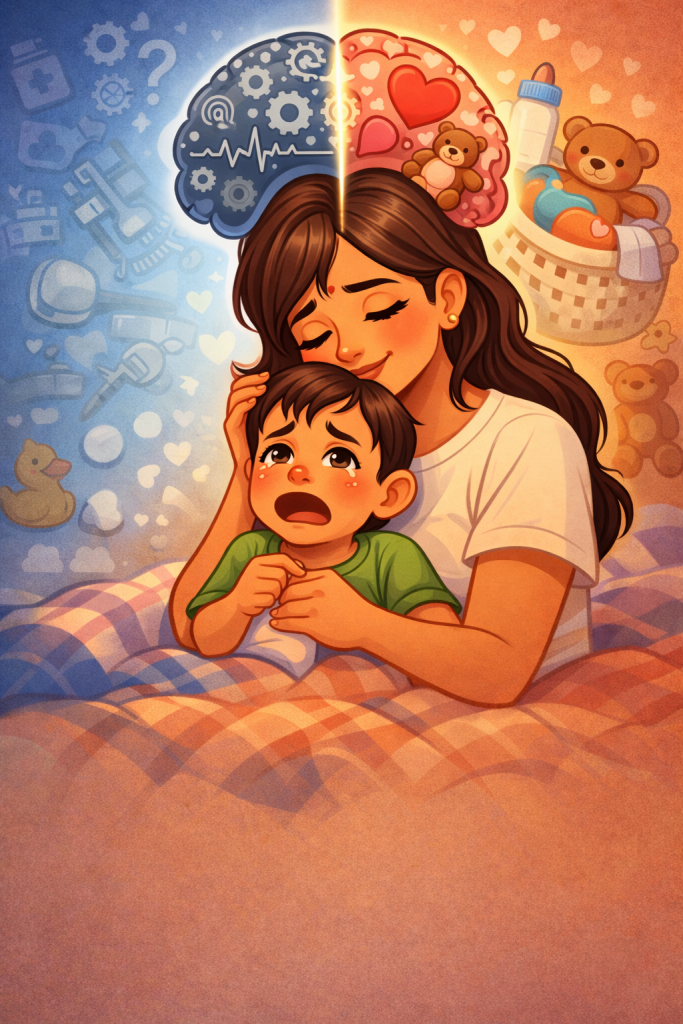
Immediately two different parts of my brain woke up. The mom brain and the pediatrician brain. I swiftly lay him down, sat on his arms, held his little face steady, and used my phone’s flashlight to look. Yup, indeed there was not a crusty yellow booger, instead something white. Probably a small wad toilet paper. My mom brain started racing, why was there toilet paper in his nose? Why did he think this would be a good choice to make?! Really proves how toddlers are scientists in their own way, how their experiments just tend to involve their own bodies.
Now pediatrician brain went into protocol mode. I kept holding him down and calmly told my husband to suction it out a bit since it is so deep inside. Slowly it came forward just enough for me to use a curette to dig it out. All the while my pediatrician brain was thinking foreign body in the nose, fairly common, usually manageable, otherwise I would have to page ENT (where would I page them?!?). My mom brain was hearing my three year old crying as I am holding him down completing this benign procedure, and I am thinking “He must hate me right now.”
And just like that, the crisis was over. The strange thing about moments like this is that while everything looks calm on the outside, inside your mind is moving just so incredibly fast. While this was happening, there was a part of my brain that was even thinking about the many times I’ve told parents in clinic to hold their child still by hugging down their arms and wrapping their legs around their child’s legs so I can look into their ears or mouth. I understood that feeling from the other side, the discomfort of having to hold your own child down while they cry, even when you know it’s necessary. While I was being the parent on the other side, holding him down, I was also in my normal role of being the one to help fix the problem as the physician. Sometimes when those two roles overlap, doctor and mom, it makes me uncomfortable in a way I can’t quite explain. Your training tells you exactly what to do, and then your heart just sees your child.
After we got the paper out, I hugged him for a long time. His breathing settled and the tears slowed. Then the evening kept moving. The older two were still sitting in the calming corner for the choices they had made right before bath time. Parenting doesn’t pause just because one small emergency happens. The laundry still needed to be started. Teeth still needed brushing. Bedtime stories still needed reading.
Life just keeps moving. And something about those moments always stays with me because becoming a parent really does change your brain. There’s actually research that shows how motherhood physically reshapes parts of your brain. Studies using MRI imaging have shown structural changes in areas related to empathy, vigilance, emotional regulation, and social understanding. These changes help mothers become more attuned to their children’s needs and more responsive to subtle cues.
In many ways, the brain becomes wired for protection, for noticing, for responding quickly. And maybe that is why I feel like those two brains are colliding. In reality, they are working together. My clinical skills helped me to stay steady in moments like last night, while being a mom has made me understand my patients and their parents/guardians in a completely different way. Medicine teaches us protocols while motherhood teaches us perspective and patience.
And we also learned how toddlers can turn something as harmless as toilet paper into a full medical scenario in under thirty seconds!
Two brains, one heart. 🫶🏽

 Embrace
Leave a comment