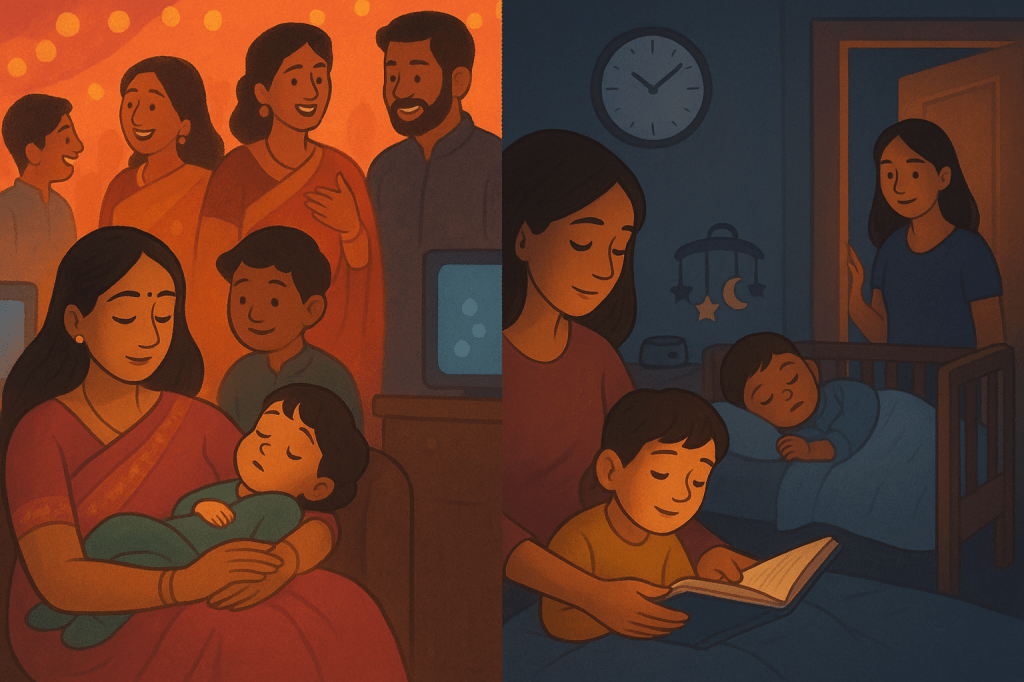
Sometimes at family gatherings, when we don’t bring the kids because of their naps or bedtime, we are always asked why we are so rigid with their sleep. Then, an aunty or an uncle will bring up how their kids (those in my generation) would fall asleep on someone’s lap at a wedding, how bed time was whenever the parents slept, and how they would even sleep with the TV was on. And look, all of our generation, according to our parents, all the aunties and uncles, “turned out fine.”
Fast-forward to us raising kids now: suddenly there are wake windows, sleep training methods, and rules like no screens an hour before bed. Our parents look at us tracking naps in an app and think we’ve completely lost it.
So what changed? Are we just “soft,” or is there actually science behind this?
Let’s break it down a bit.
I know it sounds intimidating, but essentially ” wake windows” are just stretches of time a baby or toddler can comfortably stay awake between sleep periods before becoming overtired. Through research, wake windows are based on how often children cycle through light and deep sleep and how “sleep pressure” builds up while they are awake, basically the brain’s drive to fall asleep. With time, it has been found that too little sleep or frequent sleep disruption can be linked with issues in attention, learning, mood, and physical health even like obesity. For example, sleep patterns have been found to be linked with memory consolidation and learning.
So no, wake windows aren’t a cult. They’re just a modern, practical way of respecting the biology that’s always been there. It is essentially up to you and your family to figure out the sleep patterns that work best for you and your family. Even for adults, it is important to sleep on time and without screens in the room (nudge nudge to my husband!)
With my first, we were still learning about it all. We never used wake windows or had set routines. Whenever he fell asleep, which was always upon nursing, he would fall asleep. If he got fussy, I would just start nursing and he fell asleep. It was like I was his human pacifier. We never had to plan trips or drives according to his nap because it would just happen. We traveled the world with him, never worrying about carrying a Slumberpod or a Hatch for white noise. He slept when we slept. But when we had our second, we soon realized that to preserve some rest for us in the evenings as full time working parents of two young kids, we needed a routine. The evenings were the time when we could prep bottles for the next day, could wash pump parts, settle the newborn baby, and get a few moments to ourselves. That is when we decided to sleep train our first.
That was tough because he was older, so he was very resistant to it. But once he settled into a routine, instead of being scared of bed time like he was in the beginning of the process, he used to want to jump into his crib when he was tired. I was very stressed about making sure the second baby had proper wake windows and sleep schedules, and this was during COVID so it made it simpler to do since we never really traveled anywhere. I sometimes regret my fear to deviate from the schedule, but he does really well now, so I guess it is okay. I was always trying to recreate the perfect scenario if a night goes well, just hoping for a repeat, which never really happens. It is the third baby, A, who is always more sensitive to being overtired. When he is overtired, he wakes up very early around 5am and screams. Traveling with him was a nightmare because we had to make sure we had the right set up, Slumberpod, right volume of white noise, and the pack n play all ready to go to recreate a perfect night’s rest. It never happened, he woke up at 5am regardless. It has been a struggle because all four babies now share a room and it wakes up everyone. It is a very fine line to find a good balance for all four kids since they are in the same room, and sometimes I do prioritize their naps and bed times because I know the importance of their overall well being with sleep. I am protecting their happiness by protecting their sleep.
Sleep training (in all its forms, from very gentle to more structured methods) is basically about helping babies learn to fall asleep and resettle with less help from us. It has become more a part of parenting now because we parent in a different world. We now have two working parents in a household, less extended family support, and it can really seem like consistent sleep for everyone ends up not being just a luxury, it’s survival. It is well studied that consistent bedtime routines for toddlers help with better sleep and social-emotional development over time.
Sleep training is just one tool. You don’t have to use it. But there is also nothing wrong with the idea that kids do better with predictable sleep and age-appropriate bedtimes. However you feel about this is best for your family. There is also nothing wrong with finding a happy medium between the two.
I know many will say “but we slept whenever, watched TV all day, and turned out just fine.” Here is the nuance there: with survivorship bias, the ones who turned out fine enough are the ones who say it. They may not remember those who struggled with attention, mood or school issues. Those kids were labeled as “lazy” or “hyper”, not as sleep deprived. Any child that had anxiety, headaches, or manifested signs of exhaustion were just brushed off as having personality issues, not physiological. It is important to note that we know now that even small, chronic sleep deficits can quietly impact behavior, school performance, and long term health. In the beginning of the school year, the older two boys had a very rough time in class. Once we separated bed time, and did an earlier bed time for the kids who didn’t nap and a later bedtime for the kids who did nap, it helped dramatically for school.
Another thing we should be mindful of is that the environment was different. In our parent’s generation, there were fewer screens, so less blue light in the evenings, and there was more built-in physical activity and outdoor time. However now, our kids are surrounded by bright screens that can delay melatonin release and make it harder to fall and stay asleep. This of course also applies to us adults who have smartphones in our faces at 9pm post bedtime for the kids.
So no, it’s not the same as watching a single cartoon on TV at 7 pm and then knocking out on a floor mattress in our parent’s generation.
Unfortunately, we also have higher expectations of our kids now too. They have to achieve earlier academic skills, have longer school days, and participate in more structured extracurriculars. All of that asks a lot from brains that still depend on sleep for emotional and cognitive regulation.
So giving our kids more predictable sleep isn’t about being “extra.” It’s about matching the demands of their world with the support their brains need.
You’re not disrespecting your parents by learning new data. You’re doing what they did in their time: using the best information available to care for your kids.
Our parents did the best they could with the knowledge, culture, and tools they had. Many of us did turn out fine. We now know more, live differently, and have new risks in the mix with screens, schedules ,and school demands. So what do we do?
We adjust.
I remember when I was home on maternity leave with H of losing my mind by using wake windows as a grade for my parenting. It made me feel like a failure one minute and then so confused when it succeeded the next. Instead, do what I did with the last two kid, I encourage using wake windows as a guide. Watch out for sleepy cues like rubbing eyes, rubbing ears, and zoning out, while waiting for them to get wild would be a sign of being over tired. Try to use typical wake windows as ranges, not rules. I will admit I was rigid in the beginning and then tried to be more mindful of ranges instead. My second baby needed more wake time while my third was very sensitive and needed way more sleep instead. Regressions really pushed us back multiple times, especially around 18 months (which still in my opinion, makes for the wildest and crankiest humans at that age). It is important to prioritize overall sleep and protect that time before bed to be screen free as possible. Try for reading corner, calm play, or cuddles. Make intentional choices for your family, practicing safe sleep while still blending your cultural and emotional choices as you see fit. It doesn’t mean you have to cut out the hustle and bustle of a full house at night if that is what you love! Just figure out a way to adjust your bedtime and environment that works out best for you! Lastly, you can release the guilt. This is something I am still learning to do. I don’t need to prove that the generation above us did anything wrong to justify why we do things differently. Even within our own generation we all are trying our best. From my house to my cousin’s home, sleep ranges in a variety of ways. Not to say we are doing it wrong and they are doing it right. We all try to create situations for our kids that we think will work for them, and there is no perfect standard. You also don’t ever need to feel like you are failing if your child’s sleep isn’t perfect or if you need to use an episode of their favorite show to get through witching hour. You know we have all done it to survive, and that is OKAY. Heck, we still do it to survive!
Our kids will turn out just fine. Just like our parents’ generation had intuition, community, and cultural wisdom, our generation has all that plus research on sleep, guidance on screens and routines, and greater awareness of mental health and neurodevelopment.
In books like The Anxious Generation and Hunt, Gather, Parent, there’s also this powerful reminder that sleep isn’t just about biological rhythms, it’s about cultural rhythms too. Jonathan Haidt emphasizes how modern childhood has shifted toward indoor, screen-based, and highly individual experiences, disrupting natural cues that once helped children regulate their sleep, emotions, and attention. Meanwhile, Michaeleen Doucleff shows how traditional communities, even many resembling older South Asian households, centered daily life around shared routines, physical closeness, and collective caregiving. Children slept predictably not due to rigid structure, but because the entire household moved in harmony. Both authors ultimately land on the same idea: today’s environment introduces new stressors (constant screens, overstimulation, less community support), which means children now need more intentional sleep protection than we did. It’s not about judging the past, instead it’s about adapting to the world our kids are actually growing up in now.
Our kids will turn out fine not because we recreate our own childhood conditions, but because we’re taking the parts that worked, like family closeness and flexibility, and updating the parts that didn’t, like unsafe sleep habits, chronic irregular sleep, and unlimited screens. We’re weaving the old and the new together with more compassion, both for our kids and for ourselves.
I sometimes feel guilty for being so rigid with sleep for my second after being so relaxed with my first. But I have to remind myself that I wasn’t being “extra” or “cruel” (as some used to tell me in those moments) for caring about wake windows or bedtime routines. I was doing the best I could in those moments to protect my kids sleep to maintain their happiness and health, and we found what worked for us and our four kids. While allowing them to figure it out on their own worked for our family, it may not be right for yours and that’s completely okay. What matters is honoring where we come from while using what we know now to love our children in the world they actually live in. You know yourself and your family the best. You do what YOU think is right. ❤

 Embrace
Leave a comment