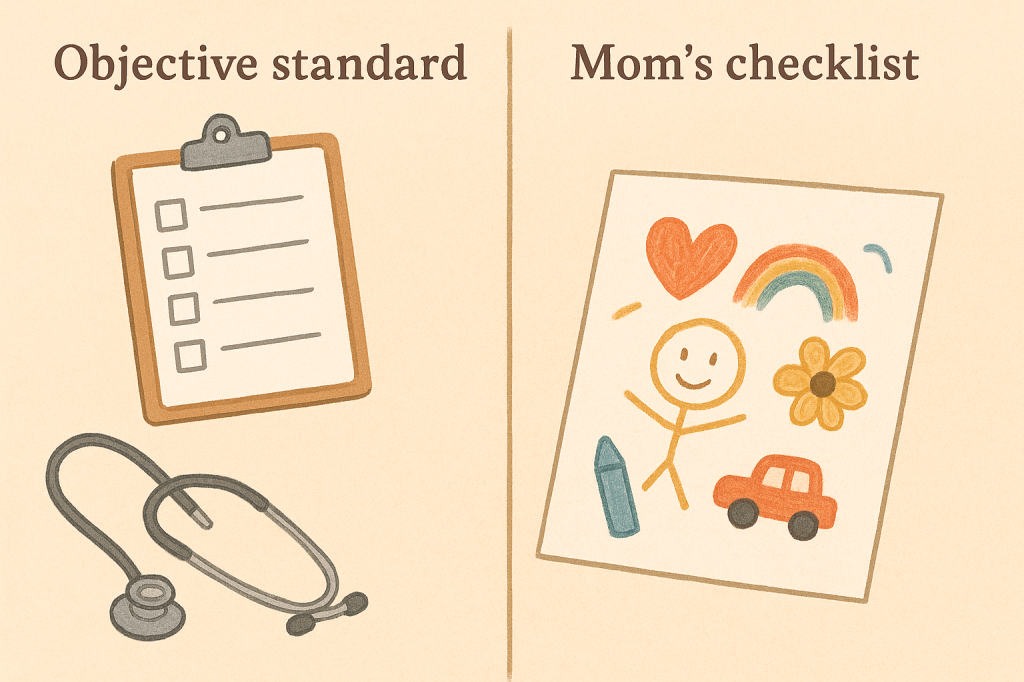
Medicine in general has an objective standard, and although each patient has their nuanced diagnoses, overall there are guidelines and algorithms to base your exams off of. I may not always have the perfect answer, but I know I am practicing to the best of my ability, guided by training, evidence, and mainly, the responsibility to advocate for my patients.
However, parenting doesn’t come with that kind of clarity. There’s no objective checklist. The supposed standard feels subjective, shifting depending on who you ask. Some days it feels like no matter what choice I make, some would say I should’ve done it differently.
But sometimes I wonder, what if we DID create an objective checklist for being the perfect mom, wife, or person? What would that even look like? Would it actually reflect what matters most to us, such as love, being present, advocacy, and grace for ourselves?
A few weeks ago, my eldest was having toileting accidents at school. Every time it happened, I carried a heavy knot of guilt in my stomach. I worried not just about the cleanup, but also about the long-term effects how it might shape the way he saw himself. I pictured him sitting there, embarrassed, while his peers whispered or laughed. Kids can be so so cruel, and the thought of him carrying that shame broke me.
But when asking him about it, I found that I was more affected by this then he was. He simply was having too much fun and did not want to leave the fun to go to the bathroom! I was spiraling on the other hand, worried about missing signs of stress and anxiety. Possible trauma. Infection. Constipation. That was not needed though. I did my due diligence though and had gotten him thoroughly evaluated by the appropriate providers, and although the answer was simple, a case of having FOMO, I kept second-guessing myself.
This happens far too often in our relationships and journey in life, marriage, and parenting. There is always that sense of self-doubt that can come in waves, and no matter what I try, I feel like I am falling short. So I have to make a change. Instead of spiraling with my own feelings, I decided to try something different to figure out what was going on.
One afternoon, while driving home, instead of running through my usual checklist of questions of asking “How was your day? Did you eat your lunch? Any accidents?”, I started talking about MY day. I told him about a difficult patient encounter and how frustrated I had felt, even though I had tried my best. I admitted that sometimes my job is really hard and that I don’t always get it right.
And slowly, he opened up. He told me about how nervous he feels when he’s in class with the bigger kids in the aftercare. He told me about the teasing he worries about. He started to share the feelings behind the accidents, not just the accidents themselves. Together we figured out how he didn’t want to leave the fun of the afternoon, and how he had been stressed recently with the bathroom in general in the facility. We came up with a solution, with positive reinforcement, decided that if he didn’t have any accidents for the week, he would get to watch the whole movie of K-POP Demon Hunters. That Sunday, we enjoyed the WHOLE movie!
That car ride reminded me of something I already knew in medicine but had forgotten in motherhood, how we have to build trust. I don’t have to be perfect to be a good parent. What my children needed was not a flawless mom with all the right answers, but an advocate for them, willing to sit in the discomfort with them and remind them they weren’t alone.
I recently saw a video by Russell Barkley, a neuropsychologist, emphasizing that children can’t simply be taught to behave perfectly. They need guidance, a good foundation, and patience. He reminds parents that guilt and self-judgment are very natural, but what children really need is consistent support, understanding, and a model of parents problem-solving, not modeling perfection. That insight reframed my own parenting. It isn’t my job to get everything right, but to provide structure, empathy, and guidance so my children can learn and grow. I am learning alongside them, in reality, and it is a truly beautiful journey. Honestly, because parenting is all trial and error. There is no single formula. What works for one child might not work for another. Even within my own family, I’ve seen that each baby needed something completely different. And just when I think I’ve figured it out, something changes. That’s the nature of raising humans because they are individuals and we are all so different.
And layered on top of that is culture. As South Asian women, many of us hold ourselves to impossibly high standards. Our mothers and grandmothers tried their best with the knowledge they had and the community mindset they were surrounded by. But their reality was very different from ours in the current world. The way they thought about feeding, sleeping, and discipline came from a completely different framework. Every generation has thoughts on how children are parented. For instance, I have heard comments like “Breast milk makes babies short” or “Sleep training is cruel, the baby should sleep with you all night” or even “Children should fear their parents.” Now, in that moment, I was so upset to hear these comments. SO MAD. Looking back, these were not said out of malice. They reflect generational biases which are shaped by their circumstances, their knowledge, and their communities. I wish that these generations would break free from those biases, but unfortunately that is rare. And when those opinions come crashing into our already tender postpartum years, they can leave deep long lasting marks.
There has been new research which shows our brains are actively rewiring for up to six years after each postpartum period. That’s a long time of vulnerability and reshaping. And how unfair is it that during this fragile season, we have to absorb not just the love and lessons from those before us, but also the judgment? We let it rewire how we parent, and worse, how we judge ourselves.
For the last few weeks, I stopped writing posts in this blog because I felt like an imposter. Why should I share about motherhood or marriage when I’m far from perfect? With all these parenting mistakes I thought I was making, any critique about my parenting or my choices made me feel small. But then I remembered: no expert is a true expert. Read that again, no parenting expert is a true expert. We’re all building our homes on our own foundations, brick by brick, in the best way we can.
And the one question that grounds me is this: if my child walked into my clinic one day, would I be proud of the care, love, and example I gave them? If the answer is yes, then I know I’m on the right path. For you, reader, are you proud of the advocacy that you provide for your child? You are on the right path for YOUR family, always remember that.
I don’t share because I’m perfect. Actually far from that, I share because I’m not. And maybe that’s the most valuable thing I can offer. Because when we open up about the messy, imperfect parts, we break down the barriers that make us feel alone.
No one’s checklist is perfect. And maybe that’s the point.
And while I am still trying to rewire my brain and unlearn some of the generational scripts passed down to me, I still hold deep respect for the women who came before. They did the best they could with the tools and knowledge available to them. My mother, grandmothers, and in-laws raised families in circumstances I will never fully understand. Their strength paved the way for mine.
But my path, and all of our paths as a new generation of women, may look different. We honor them not by repeating every method, but by carrying forward their resilience while allowing ourselves the freedom to parent in ways that reflect today’s world, our children’s needs, and our own evolving wisdom.

 Embrace
Leave a comment